
We may as well begin with the big question and get it out of the way right off the bat. Why did the Hindenburg burn?
(Brace yourselves, folks. This could be a bit of a long haul…)
As he stumbled away from the blazing wreck of what had, moments before, been the newest and most technologically advanced airship in the world, Captain Ernst Lehmann, Director of Flight Operations for the Zeppelin Company (the Deutsche Zeppelin-Reederei, or DZR) and the former commander of the Hindenburg, muttered the same puzzled statement to himself, over and over in German: “Das verstehe ich nicht…”
“I don’t understand it.”
Lehmann, with over 25 years experience as an airship captain, couldn’t fathom how the Hindenburg could have possibly burned while hovering nearly motionless in the air. Yes, it had been filled with inflammable hydrogen gas, but the Germans had been flying passenger airships lifted by hydrogen since before WWI, and had never had a single passenger injury, let alone a sudden fire like this during a routine landing. Hydrogen, after all, was only flammable once mixed with a sufficient amount of oxygen, and the German airship operators had perfected the art of maintaining hydrogen purity to the point where they simply did not consider a hydrogen fire to be a realistic danger.
In fact, the previous year Lehmann had had a conversation with the Deutsche Zeppelin-Reederei’s U.S. representative, Willy von Meister, in which they had discussed the possibility of a deal under which the DZR might allow U.S. Navy officers to train aboard the Hindenburg during each of her North American flights in exchange for helium being made available for German airships (which, under U.S. Congressional legislation, was not currently possible.) Lehmann’s response was indicative of the Germans’ staunch belief in their ability to safely manage their hydrogen: "That is really no inducement; we have been operating our commercial service with hydrogen very successfully for years."
"My dear Lehmann,” von Meister responded, “I sincerely hope you will not have cause to regret your opinion."
And, less than a year later, here they were with the Hindenburg lying in ruins on the Lakehurst Naval Air Station’s landing field and a large number of its passengers and crew either dead or badly injured. Ernst Lehmann himself would die of his burns the day following the disaster.
So, what did happen?
Numerous theories were advanced both in the press and amongst the airshipmen themselves even before the Hindenburg’s wreckage had cooled: perhaps lightning had struck the ship; a broken propeller may have been flung into the hull; sparks from a backfiring engine could have started the fire; there could have been a short circuit in the ship’s electrical system, electrostatic discharge from St. Elmo’s fire could have been the culprit…and, of course, there were those who suspected a far more dramatic cause – sabotage.
A Question of Sabotage
The possibility of deliberate destruction of the Hindenburg by a saboteur was something that had been considered by practically everyone connected with the Zeppelin enterprise since before the ship had even made her maiden flight. The international political climate had steadily deteriorated ever since Germany’s Nazi government had begun to remilitarize their nation, and it had been a matter of increasing concern among German and American officials alike that the Hindenburg and her sister ship, the Graf Zeppelin, their tails painted with huge swastikas, might become targets for a sabotage attempt by somebody seeking to strike a blow at the Nazis. The DZR had received numerous bomb threats via mail throughout the previous year, warning that the Hindenburg would be destroyed. In fact, when Captain Lehmann boarded the airship for her last flight, he carried one of these letters in the pocket of his leather aviator coat. When the Hindenburg burned over the Lakehurst airfield three days later, many people’s thoughts turned instinctively to the question of sabotage.
Even Dr. Hugo Eckener, head of the Luftshiffbau Zeppelin and one of the most well-respected airship commanders in the world, made a brief initial public statement a few hours after the disaster that he considered sabotage to be a highly likely cause. This, however, was based on the initial telephone call that Eckener had received informing him of the disaster in which it was stated that the Hindenburg had “exploded” in mid-air during its landing approach. Eckener knew that there was no way for the Hindenburg to have literally exploded unless foul play were involved.
However, as more details were relayed to him throughout the day, it quickly became obvious to Eckener that the Hindenburg had burned and not exploded. He revised his statements to the press to reflect this, attempting to steer reporters away from the sabotage theory. Nevertheless, the newspapers, anxious to continue to inject as much drama as possible into the story, continued to focus on sabotage even as the official investigation pursued other possibilities.
Commander Charles E. Rosendahl, base commander at Lakehurst, was also of the strong opinion that the Hindenburg had been sabotaged. Though he was later forced to admit the questionable nature of the sabotage theory since officials hadn’t found a single shred of evidence in the wreckage to indicate the presence of an incendiary device, Rosendahl was nevertheless a staunch advocate of the notion that the Hindenburg had been brought down deliberately. The day after the fire, he had sat beside the hospital bed of his old friend Ernst Lehmann and together the veteran airshipmen went through every imaginable possibility as to what may have caused the disaster, eliminating them one by one. At last, Lehmann wearily told Rosendahl, “It must have been an infernal machine.”
Commander Rosendahl seems to have taken Lehmann’s statement to heart, and though he kept his official statements measured, both to the press and to the official investigation board, privately he became more and more convinced that the Hindenburg had been sabotaged. He even had a suspect in mind, a passenger whom several surviving crew members insisted had made multiple unaccompanied trips into the ship’s interior to feed his dog, which happened to be kenneled in a freight room near the tail of the ship. “The man with the dog”, Joseph Spah, was subsequently investigated by the FBI, who turned up absolutely no evidence to support these suspicions. Spah, an international vaudeville performer, was found by the Bureau to be a good family man with no suspicious ties, and the FBI concluded that he had nothing to do with the Hindenburg fire. In fact, no evidence, suspect or motive for sabotage was ever uncovered by any of the official investigators.
But the sabotage theory refused to die. 25 years later, an American author named A. A. Hoehling published a book entitled, “Who Destroyed The Hindenburg?” in which he indicated that a member of the Hindenburg’s crew, a rigger named Erich Spehl, may have planted a time bomb in one of the ship’s aft gas cells at the behest of his girlfriend, whom Hoehling claimed to have been a member of the anti-Nazi resistance in Germany. It was a slick story, and one which was perhaps convincing enough to those who had only a passing knowledge of Zeppelin history. Hoehling cherry-picked evidence that appeared to support his theory and, perhaps concerned about possible libel accusations (though Erich Spehl himself was unable to speak out, as he had died in the disaster) he stopped just short of stating conclusively that Spehl had indeed destroyed the ship.
In fact, there was absolutely no evidence to suggest that Erich Spehl had anything to do with the destruction of the Hindenburg. Even the circumstantial evidence with which Hoehling attempted to support his theory was paper thin, and in many cases involved interpretations of statements made by interview subjects who later strongly disputed those interpretations. Furthermore, subsequent research conducted by a relative of Erich Spehl indicated that much of Hoehling’s sabotage theory came not from Hoehling’s own research, but from the imagination of the son of one of the Hindenburg’s officers.
Nonetheless, the name Erich Spehl had now been tied to the sabotage theory. Ten years later, author Michael M. Mooney, fulfilling the terms of a deal he had made with Universal Pictures to write a book upon which they would base a major motion picture, expanded on Hoehling’s characterization of Erich Spehl in his book, “The Hindenburg”. Whereas Hoehling’s book had primarily consisted of factual reportage with the sabotage theory more or less tacked on during the concluding chapters, Mooney’s book took a great many artistic liberties, to the point where Erich Spehl and numerous others were practically rewritten as fictional characters. Both Hoehling and Mooney’s books have been roundly dismissed by airship historians as opportunistic nonsense (to put it charitably), although the Spehl theory does continue to be referenced from time to time in articles and documentaries on the subject. To this day, however, no reputable evidence has come to light to indicate that the Hindenburg was sabotaged by Erich Spehl, Joseph Spah or anyone else.
Painted With Rocket Fuel?
In 1996, retired NASA scientist Dr. Addison Bain put forth a new theory, in which he stated that the doping compound applied to the Hindenburg’s outer cover was highly flammable and, in fact, the initial source of ignition for the Hindenburg fire as well as being the cause of the rapid spread of the fire. According to Bain's theory, known also as the Incendiary Paint Theory, electrostatic discharge across the ship's upper starboard hull, triggered by the release of negatively-charged carbon particles in the exhaust of a backfiring engine, ignited the ship's fabric outer covering. The outer cover then, rather than the hydrogen contained within the ship was, under this thaory, allegedly the driving force behind the sudden and rapid burning of the Hindenburg.
The Hindenburg’s outer cover was treated with a cellulose-acetate butyrate varnish, applied in multiple coats, in order to keep the cover taut and to strengthen it against the elements. There was aluminum powder mixed into this compound in order to reflect the sun’s heat, the effects of which would cause the ship’s hydrogen to expand and eventually be released through the ship’s automatic over-pressure valves. Thus, the Hindenburg’s silver coloration was primarily intended to control expenditure of hydrogen lifting gas.
That coloration was also, according to Bain, the reason for the Hindenburg fire. He proposed that the addition of the aluminum powder to the cellulose-acetate butyrate doping compound, particularly when combined with iron oxide (with which the underside of the outer cover was coated above the ship’s equator to prevent damage to the gas cells from direct exposure to UV radiation) created a mixture that was highly flammable and similar to the fuel used in the Space Shuttle’s solid rocket boosters.
Similar, but not identical. Herein lies one of the problems with this particular theory.
Solid rocket fuel does contain both aluminum powder and iron oxide (16% and 0.2% of the total mixture, respectively) but just a fraction under 70% of the mixture is ammonium perchlorate, the oxidizer which allows the fuel to burn.
The Hindenburg's doping compound, on the other hand, did contain aluminum powder and iron oxide, but in separate coats and suspended in cellulose-acetate butyrate - which was itself used because of its low flammability. There was no ammonium perchlorate or comparable compound on the Hindenburg's outer cover varnish. While the doping compound had some of the ingredients used in solid rocket fuel, it was not the same thing. The Hindenburg was not, therefore "painted with rocket fuel" as Dr. Bain has claimed.
Subsequent burn tests performed by researchers on fabric samples coated with the identical doping compound showed that it burns far too slowly to have destroyed the Hindenburg in the 34 seconds that it took for the entire ship to be consumed. And, in fact, it the doped fabric will self-extinguish if the heat source is removed. For a full analysis of this, I highly recommend reading the report by Dr. Alex Dessler, Donald Overs and William Appleby in which they describe their tests and the results:
http://spot.colorado.edu/~dziadeck/zf/LZ129fire2005jan12.pdf.
Dr. Dessler also published a preliminary paper prior to his collaboration with Overs and Appleby, in which he outlined the areas in which he felt that the Incendiary Paint Theory was fatally flawed. It is also recommended reading:
http://spot.colorado.edu/~dziadeck/zf/LZ129fire.pdf
In addition to the problems with the science behind the Incendiary Paint Theory, there is also the fact that it tends to contradict some very basic facts as described by eyewitnesses and apparent in the film footage of the blaze. First and foremost, the Hindenburg can be seen very clearly burning from the inside out, as opposed to burning from the outer cover into the gas cells as Bain's Incendiary Paint Theory holds. This is supported by the testimony of numerous eyewitnesses, including surviving crew members who witnessed the spread of the fire from their landing stations within the airship.
I find the statements of two of the crew members in particular to be of vital importance in illustrating this. Helmut Lau was a 25 year-old helmsman whose landing station was in the Hindenburg's lower tail fin. He was assisting Hans Freund, one of the ship's riggers, as Freund was hoisting a coil of mooring cable into position on the keel above the fin. Lau, as he later testified, "was looking up and was facing the port side of the fin," when he heard what he later described as a "frwump" sound, similar to the burner on a gas stove being lit.
His official testimony proceeds as follows:
"I heard over me a muffled detonation and looked up and saw from the starboard side down inside the gas cell a bright reflection on the front bulkhead of cell No. 4. The gas cell was approximately at the line that I have indicated on Exhibit 10. I therefore could see from there to the point that I am indicating. I could see from my position at this point to approximately the position indicated. Here and here I saw no fire at first. I saw it on the front side of cell 4. The bright reflection in the cell was inside. I saw it through the cell. It was at first red and yellow and there was smoke in it. The cell did not burst on the lower side. The cell suddenly disappeared by the heat."
"The fire proceeded further down and then it got air. The flame became very bright and the fire rose up to the side, more to the starboard side, as I remember seeing it, and I saw that with the flame aluminum parts and fabric parts were thrown up. In that same moment the forward cell and the back cell of cell 4 also caught fire, cell 3 and cell 5. At that time parts of girders, molten aluminum and fabric parts started to tumble down from the top. The whole thing only lasted a fraction of a second."
"I turned around and pulled in my head - I had no hat on - and jumped back underneath the girder to which the telephone is attached. Whilst I was jumping back, I noticed that the ship was dropping rapidly. The ship at the moment that the explosion went up had an acceleration down."
In other words, Lau heard something very much like gas being ignited, which drew his attention up and forward to a fiery glow which he very clearly placed as having been on the front of gas cell #4, just ahead of the tail fins at Ring 62 (the main structural ring located 62 meters forward of the aft-most point of the hull.) The witness diagram (shown below) which Lau filled out during his testimony further places the fire at approximately at the level of the axial catwalk that tunneled through the center of the gas cells. This fire, as Lau later clarified in his testimony, appeared to be burning its way downward along the front side of cell 4, and almost immediately consumed cell 4. The fire then burned upward and out through the top of the ship as the surrounding gas cells ignited, at which point the entire structure shook violently.
Thus, we have a witness who saw the fire burning inside the ship prior to the second detonation that was captured by still photo and newsreel photographers. Furthermore, the fire spread AFTER cell 4 had been breached, flooding that part of the ship's interior with hydrogen.

The diagram filled out by Helmut Lau during his testimony, showing his position, his line of sight, and the area where he first saw the fire. The stern view shows the path he saw the fire take once it rose back up and burst through the top of the hull.
A second witness whose testimony is notable for its detail about the spread of the fire is Kurt Bauer, one of the ship's elevatormen. Bauer was standing along the ship's keel, between the control car and the tip of the bow. He was one of only three men of the twelve crew stationed in the bow section who survived the disaster. He was looking through a hatchway, one of the pair of triangular air vents that flanked the keel walkway beneath gas cell 15, and was watching the ground crew taking up the landing ropes. Bauer later described to the Board of Inquiry what happened. From his official testimony:
"I noticed a cracking shock which originated from the rear. Before I could mention what could have happened, I saw a yellow flame over me in the axial walkway. Then the ship took on an inclination so steeply that I had to take hold of myself. Everything all around me burned, especially over me. The flames were quite close to me, on top of me."
This is important, because it indicates that the fire shot forward along the axial catwalk immediately after fire burst out of the aft hull of the ship, before the ship had even begun to lose buoyancy in its tail section.

Kurt Bauer’s position at the time of the fire, with the approximate progress of the fire along the axial catwalk when Bauer first observed it, while the Hindenburg was still on an even keel. (Diagram courtesy of David Fowler)
Later in Bauer's testimony, investigator South Trimble asked Bauer to clarify the sequence of events.
Trimble: "Did you see fire in the axial corridor before any inclination took place?
Bauer: "Yes, sir. It must have been a fraction of a second later, after the explosion."
Trimble: "Which came first, the vibration, the shock or the fire?"
Bauer: "The shock came first, and about half a second later I saw the fire."
Trimble: "Then when did the inclination of the ship take place?"
Bauer: "Shortly after that."
Clearly then, the Hindenburg fire spread internally much faster than it spread along the outer cover.
First Thought, Best Thought
For over 75 years, the cause of the Hindenburg fire has been considered a mystery, particularly by those with an interest in putting forth a bold new attention-grabbing theory. The sabotage theory has been used repeatedly over the years in order to sell books and movie tickets. The Incendiary Paint Theory was the result of Addison Bain's desire to improve public opinion of hydrogen as an alternative fuel source by exonerating hydrogen as the cause of the Hindenburg disaster as a way of dealing with the so-called "Hindenburg problem" – the tendency for the Hindenburg disaster to be brought up as an argument against developing hydrogen as an environmentally friendly fuel. While I do not agree with Dr. Bain's conclusions about the cause of the Hindenburg fire, I certainly share his firm support for the development of renewable fuel sources.
As for the authors who attempted to cash in on baseless sabotage theories involving a man who was not alive to defend himself against potentially libelous charges, I have little use for their motives or their means of fulfilling those motives. I think it should go without saying that when one purports to present a non-fictional account of an historical event, indulging in a tendency to favor drama over accuracy undermines the value of the entire project. In my examination of much of the same primary source material used by A. A. Hoehling during the writing of his book, I notice that he did get a great deal of his facts correct, up to the point at which he began delving into his sabotage theory. Had he avoided the subject of sabotage altogether and focused purely on factual reportage and more in-depth interviews with survivors and eyewitnesses, I cannot help but think that he may well have ended up publishing a solid, well-regarded reference book on the Hindenburg disaster. As it is, airship historians have rightly dismissed “Who Destroyed The Hindenburg?” as frivolous nonsense since it was published in 1962.
So, it wasn’t sabotage, and it wasn’t the outer cover. Where does that leave us? In my opinion, having studied the matter for over 35 years, it leaves us right where investigators settled back in the summer of 1937. It is my belief that those who ran the Hindenburg investigation, particularly Dr. Eckener, got it right from almost the very beginning.
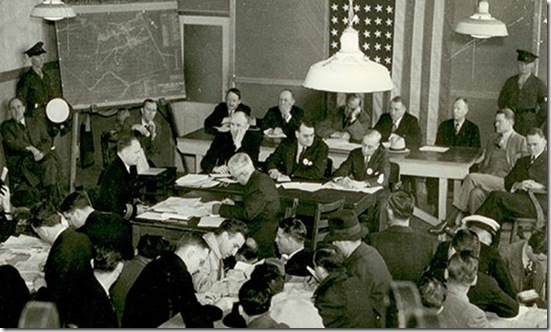
U.S. Commerce Department’s Board of Inquiry into the Hindenburg disaster. First day of proceedings - May 10th, 1937.
The US Commerce Department's Board of Inquiry into the Hindenburg disaster lasted less than three weeks, from May 10, 1937 (the Monday following the crash) through May 29th. Given the deteriorating political environment where Germany was concerned, coupled with the fact that a German airship had been destroyed on a United States military reservation, investigators from both the American and German commissions seem to have felt the need to balance the need for a thorough investigation with the need to quickly reach a mutually acceptable conclusion as to the cause of the disaster.
Numerous ideas were floated at the time as to possible sources for the Hindenburg fire. Lightning was a prime candidate, due to the stormy weather conditions that had existed over Lakehurst shortly before the ship was cleared to land. However, nobody on the ship or on the ground witnessed any lightning at any point throughout the landing maneuver, and meteorological data from Lakehurst’s aerology station did not show there to have been suitable conditions for a lightning strike at the time of the disaster.
Another theory was that there may have been some sort of engine malfunction, either a broken propeller that had been hurled into the ship’s hull or perhaps an engine backfire that had produced sparks that penetrated the hull and ignited the hydrogen. Investigation of the remains of the engine gondolas indicated that although there was some splintering of some of the propeller blades, this was due to the props having still been rotating when they hit the ground.
The engine exhaust theory was rejected by the Board of Inquiry due to two factors. First, engine exhaust sparks from the Hindenburg’s diesel engines were relatively cool (200-250 degrees centigrade, or 392-482 degrees Fahrenheit) while the ignition temperature of hydrogen was much higher (600-700 degrees centigrade, or 1112-1292 degrees Fahrenheit.) Secondly, the first indication of fire was much too far up the ship’s hull for engine sparks all the way at the bottom of the hull to have been able to start the fire.
The possibility of a short circuit somewhere in the Hindenburg’s electrical systems was also taken into consideration. However, Chief Electrician Philipp Lenz had been in the electrical center at the time of the fire standing next to the electrical system’s switch board. He testified that no fuses blew and no circuit breakers tripped at any time prior to the fire. In addition, the only electrical circuits that ran at the level of the axial catwalk were the running lights at the extreme bow and stern of the ship, and neither of these were anywhere near the area where the fire had apparently begun. This theory, therefore, was also rejected as a possibility.
With most of the prevailing theories falling by the wayside as the investigation progressed, what was left?
Dr. Hugo Eckener, who headed up the German commission, was considered to be one of the foremost experts in the world in the operation of Zeppelin airships. He had been an airship pilot since 1911, had trained German Zeppelin crews during the First World War, and had commanded every post-war airship that the Luftschiffbau Zeppelin had produced, including the Graf Zeppelin on its flights around the globe and to the Arctic. His reputation as an airship commander was impeccable, and his understanding of the design and operation of Zeppelins made him perhaps the single investigation official whom people assumed would be most likely to come up with "the" definitive answer as to what had caused the Hindenburg fire.
Eckener spent two hours addressing the Board on May 22nd, 1937. Several key witnesses, including First Officer Albert Sammt, had not yet been heard. However, Eckener had formed some very definite impressions from the witnesses heard thus far, and presented them in his official testimony, along with his summation of what he believed to be the most likely theory.
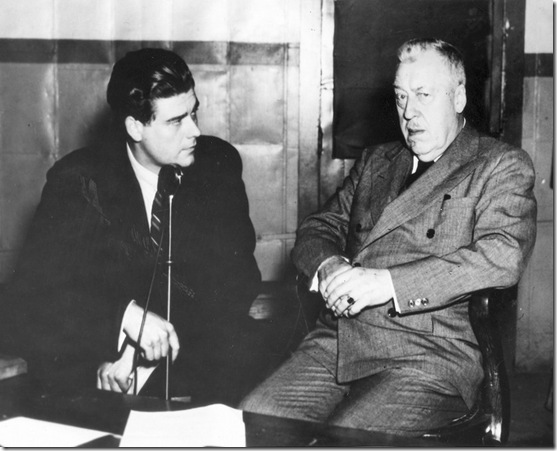 Dr. Eckener, at right, during his testimony before the Board of Inquiry. Willy von Meister, at left, translated his statement into English.
He noted that the Hindenburg was significantly tail-heavy and "badly out of trim" as it approached the mooring mast. He estimated that the command crew had generated between 70,000 and 80,000 kilogram-meters (approximately 505,000 to 580,000 foot-pounds) of trimming effect, between ballast dropped from the aft portion of the ship, hydrogen valved from the forward section, and the six crewmen sent forward to the bow to compensate for the tail-heaviness.
In addition, he described the meteorological conditions at the time of the fire, with a thunderstorm front having just moved out of the area and a likely secondary, smaller storm front arriving behind the first one. This, he noted, would have created a significant difference in electrical potential between the ship and the ground. This would have slowly equalized once the landing ropes were dropped and became damp and conductive in the light rain that was falling. At this point, he says, the electrical potential gradient would have increased between the ship and the air mass above it, thus providing the conditions for electrostatic discharge atop the ship's hull.
All that was needed at this point was something for the static discharge to ignite. Eckener explained his theory this way:
”The ship proceeded in a sharp turn to approach for its landing. That generates extremely high tension in the after part of the ship, and especially in the center sections close to the stabilizing fins which are braced by shear wires. I can imagine that one of these shear wires parted and caused a rent in a gas cell. If we will assume this further, then what happened subsequently can be fitted in to what observers have testified to here: Gas escaped from the torn cell upwards and filled up the space between the outer cover and the cells in the rear part of the ship, and then this quantity of gas which we have assumed in the hypothesis was ignited by a static spark.”
”Under these conditions, naturally, the gas accumulated between the gas cells and the outer cover must have been a very rich gas. That means it was not an explosive mixture of hydrogen, but more of a pure hydrogen. The loss of gas must have been appreciable.”
“I would like to insert here, because the necessary trimming moments to keep the ship on an even keel were appreciable, and everything apparently happened in the last five or six minutes, that is, during the sharp turn preceding the landing maneuver, that therefore there must have been a rich gas mixture up there, or possibly pure gas, and such gas does not burn in the form of an explosion. It burns off slowly, particularly because it was in an enclosed space between outer cover and gas cells, and only in the moment when gas cells are burned by the burning off of this gas, then the gas escapes in greater volume, and then the explosions can occur, which have been reported to us at a later stage of the accident by so many witnesses.”
”The rest it is not necessary for me to explain, and in conclusion, I would like to state this appears to me to be a possible explanation, based on weighing all of the testimony that I have heard so far.”
Personally, I believe that this is probably very close to what actually occurred. I do differ with Dr. Eckener on one or two points of detail, however overall I think that he got it more or less right – and this was less than two weeks following the disaster. In my opinion, this was a confluence of very specific factors and events, the absence of any one of which might have prevented the disaster:
1.) The Hindenburg experienced a significant loss of hydrogen from one of its aft gas cells (most likely Cell 4) during its landing approach. The two most likely causes for this would be a.) a broken bracing wire on the front of the cell causing a tear in the gas cell, or b.) a gas valve that failed to close firmly after hydrogen was valved to reduce the ship’s altitude.
2.) The free hydrogen combined with the surrounding air and produced a flammable oxyhydrogen mixture. This mixture began to fill either the space between the gas cells, or the vertical gas ventilation shaft.
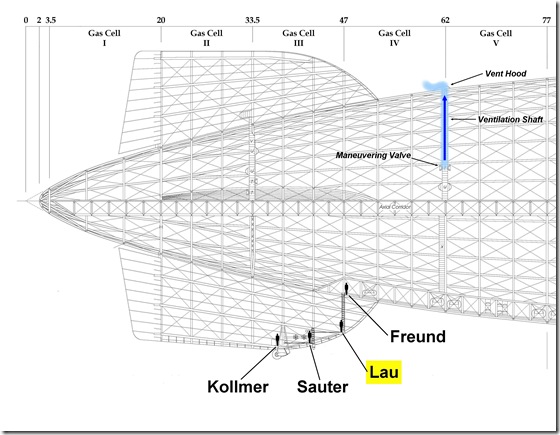 An illustration of oxyhydrogen from a stuck gas valve rising up the ventilation shaft and out the vent hood atop the Hindenburg’s hull. (Diagram courtesy of David Fowler)
3.) The stormy weather through which the Hindenburg had flown had created a significant electrostatic charge throughout the ship’s structure.
4.) The Hindenburg was brought up to the mooring mast for a “high landing” at a height of between 150 and 200 feet in preparation for dropping its landing ropes. This created a significant difference in electrostatic potential between the ship and the ground – far moreso than would have been the case during the “low landing” that the Germans traditionally made in which the landing lines were dropped when the ship was less than 50 feet above the ground.
5.) The ship’s manila landing ropes were dropped. Though the ropes were dry and not particularly conductive at first, as they became wet in the light rain they gradually began to ground the airship.
6.) The Hindenburg’s metal framework became grounded faster than its outer cover, which was less conductive and also isolated from the longitudinal girders by wooden dowels as an anti-chafing measure. This created electrostatic discharge between the outer cover and the framework.
7.) The fact that the outer cover was wet with rainwater further increased the likelihood of electrostatic discharge, particularly atop the Hindenburg’s hull.
 Electrostatic discharge begins along the top of the Hindenburg’s hull as oxyhydrogen continues to rise upward from the gas leak. (Diagram courtesy of David Fowler)
8.) Eventually this electrostatic discharge occurred in the vicinity of the oxyhydrogen mixture that was still present in the tail section, igniting the oxyhydrogen. The fire then burned back to the source of the leak (again, either moving down between the gas cells on the forward side of Cell 4 to a rip in the gas cell material, or else down the vertical ventilation shaft between Cells 4 and 5 to a leaking gas valve.)
 Escaping oxyhydrogen is ignited by electrostatic discharge atop the ship, and the fire burns straight down to the spot from which the hydrogen is leaking. (Diagram courtesy of David Fowler)
9.) Once the fire had burned back to the source of the leak, it ignited the gas cell material.
At this point, nothing could stop the fire. The gas cell material itself burned fairly quickly, and Cell 4 basically melted – “disappeared by the heat”, as Helmut Lau phrased it. With tens of thousands of cubic feet of hydrogen suddenly released into the open hull and the surrounding gas cells now burning, the fire blazed upward and outward, bursting through the top and sides of the hull and igniting the other gas cells in the aft half of the ship, which were also quickly breached, adding even more oxyhydrogen to the conflagration.
In other words, what actually happened to the Hindenburg was probably not all that different from the answer at which Dr. Eckener and the other Board of Inquiry investigators originally arrived in 1937.
“Recommend Landing Now…”
Lets take a look at the Hindenburg’s final landing approach and I’ll walk through the sequence of events as I see it.
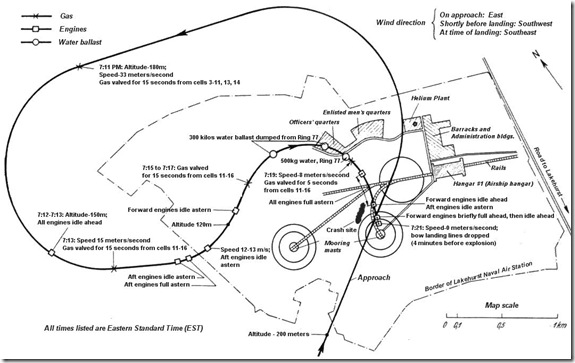 Annotated map of the Hindenburg’s landing approach, with information compiled by the Board of Inquiry from eyewitness testimony, particularly that of Captains Heinrich Bauer and Walter Ziegler.
7:00 PM - The Hindenburg is making her approach to the landing field at Lakehurst, more than 12 hours behind schedule due to persistent headwinds over the North Atlantic. Captain Max Pruss is in command of the ship, with Ernst Lehmann, the DZR’s Director of Flight Operations and Pruss' former commander aboard the flight as an observer. This is the first North American flight of the 1937 season, and there is a full load of 72 passengers waiting at their hotel in New York City for the return flight. Many of them are on their way to England for the coronation of King George VI on May 12th, and will be cutting it rather closely as it is. It can be safely assumed that Captain Pruss is under at least some pressure to make the landing as soon as possible.
7:05 PM – Captain Pruss observes the wind conditions and the position of the ground crew and prepares for landing by ordering the helmsman to make a wide turn to the west, far beyond the air station's boundary, intending to bring the ship in to moor in an easterly direction.
7:10 PM - Navigator Eduard Boetius sounds the signal for the Hindenburg's crew to take their landing stations.
7:11 PM - First Officer Captain Albert Sammt, issuing orders involving trim and altitude while Captain Pruss issues orders related to direction and engine speed, orders Captain Walter Ziegler to open the master control wheel on the gas valving board for 15 seconds. Known by airshipmen as “valving on the wheel,” this vents hydrogen from cells 3 through 11, plus cells 13 and 14 in order to bring the ship's altitude down for its final landing approach.
 The Hindenburg’s gas board is shown at left. The large wheel at upper left would release hydrogen from 12 of the ship’s 16 gas cells simultaneously. The line of small individual toggles to the right of the wheel controlled each gas cell individually. The gauges below the valving controls monitored the fullness of each gas cell. Photo is from a flight in 1936.
7:10-7:11 PM - Captain Sammt orders Eduard Boetius to relieve elevatorman trainee Ludwig Felber at the elevator wheel due to Boetius being more experienced. Felber is sent to the mooring shelf at the bow in order to assist with the lowering of the forward landing lines. Navigator Christian Nielsen sounds the landing stations signal for the second and final time.
 Eduard Boetius at the Hindenburg’s elevator wheel, facing the port side of the control car. This photo was taken sometime during autumn of 1936.
7:13 PM - Captain Pruss orders all four engines reduced to "idle ahead" in order to reduce the ship's forward speed. Meanwhile, the command crew has noticed that the ship is out of trim and heavy astern. Captain Sammt orders Captain Ziegler to pull the manual release valves for gas cells 11 through 16 for 15 seconds in an attempt to bring the ship into trim.
** At this point in the landing approach, it is reasonable to assume that whatever damage to cell 4 has occurred, whether a tear in the front of the cell or a valve cover that didn’t completely close after the valving 2-3 minutes before, is allowing enough hydrogen to escape that it is beginning to effect the Hindenburg’s ability to remain in trim. Meanwhile, an oxyhydrogen mixture is beginning to form in the Hindenburg’s stern, either as a vertical plume rising up the ventilation shaft between cells 4 and 5 if the leak is from a gas valve, or throughout the narrow gap between gas cells 4 and 5, eventually moving laterally along the space between the gas cells and the ship’s outer cover.
7:14 PM - The Hindenburg crosses the Lakehurst Naval Air Station's western boundary. Captain Pruss notices that the wind has shifted and the ground crew is now lined up directly north of the mooring mast. The ship will now need to make its approach due south rather than in the easterly direction Pruss had anticipated. Perhaps because of concerns over the already-delayed landing, Pruss (possibly with Lehmann's counsel, we don't know for sure) opts against the standard operating procedure of making another full-speed pass around the airfield in order to line up with the new wind direction and to allow the slipstream to fully vent the hydrogen that Ziegler has just valved from the forward cells. Instead, Pruss decides to bring the Hindenburg up to the mooring mast in a tight S-curve, which will end with the ship facing due south.

The Hindenburg, still far to the west, approaches the landing field after making its wide, sweeping turn to the northwest. She appears to be slightly nose-down, which would make sense as she was descending in preparation for mooring. Eduard Boetius, at the elevator wheel, is also attempting to counter the ship’s tail-heaviness, and the apparent nose-down attitude may also be partly due to this.
7:15 PM - The ship is still out of trim and tail-heavy. Captain Sammt orders Captain Ziegler to valve hydrogen from the same gas cells, 11 through 16, for another 15 seconds. The ship is turning to port in anticipation of a hard turn to starboard to line up with the wind.
7:17-7:18 PM - The ship begins its turn to starboard. This is the beginning of the "sharp turn" that Dr. Eckener would later blame for the damage to cell 4. Note that the command crew began valving gas from the forward cells several minutes prior to this in order to correct the ship's "badly out of trim" condition. If we assume that the persistent tail-heaviness is connected with the hydrogen leak that will doom the ship a few minutes later, then we must also assume that Dr. Eckener was in error in his belief that the final sharp turn to starboard was to blame for the damage to cell 4 and the hydrogen leak.
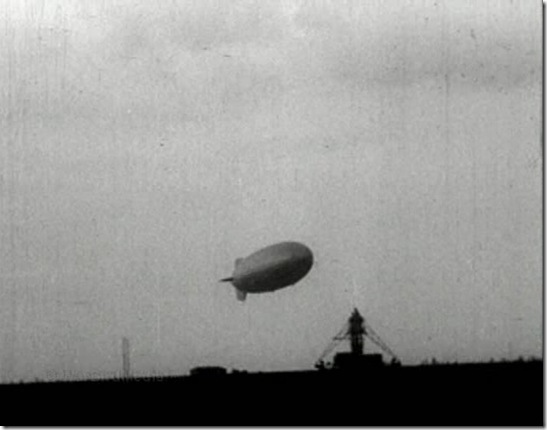
Now appearing to be slightly up by the nose, the Hindenburg begins its final turn up to the mooring area. The mooring mast in the foreground is not the one to which the ship will dock, although it was the mast the Hindenburg had used throughout the previous year.
7:18 PM - With the ship still tail heavy, Captain Sammt orders Captain Heinrich Bauer (no relation to Kurt Bauer), who is manning the ballast release board, to drop 300 kg of water ballast from Ring 77 (the main framework ring located 77 meters forward of the aft-most point of the ship) near the ship's stern. According to Sammt's autobiography written years later, he experiences a few moments of anxiety as he watches the plume of water falling between the ship and the ground, concerned that perhaps it might create some type of electrostatic discharge. It does not appear to do so, however, and shortly after this Sammt orders another 300 kg of water dropped from Ring 77.

As the Hindenburg’s turn to starboard becomes sharper, water ballast is dropped from the aft section.
7:19 PM – Captain Sammt orders one more ballast drop from Ring 77, this time of 500 kg, and simultaneously orders Ziegler to valve cells 11 through 16 once more, this time for 5 seconds. Sammt also rings the telephone extension in the crew's mess to order six men to go forward to the bow in order to use their body weight to help bring the bow down. At the elevator wheel, Eduard Boetius is holding the elevators hard down, attempting to coax as much trimming effect out of them as possible as the ship slows its forward speed to 8 meters per second. The ship is obviously still very much out of trim and down by the tail.

The Hindenburg makes its third and final ballast drop as it approaches the fenced-in visitors’ area in front of Hangar One, in which the ship had been docked twice the previous year. The line of people visible in front of the fence include those onhand to greet various passengers and crew members as well as locals who are just there to witness the landing.
7:20 PM - With the Hindenburg now only a few ship's lengths away from the mooring mast, Captain Pruss orders all engines full astern in order to check her speed. Then he orders the forward engines to idle ahead and the aft engines to idle astern, so that they can be ready for a quick burst forward or aft, as needed to position the ship for mooring. Pruss orders full ahead briefly, and then back to idle ahead. The six men from the crew's mess have now reached their positions along the keel walkway leading up to the bow.
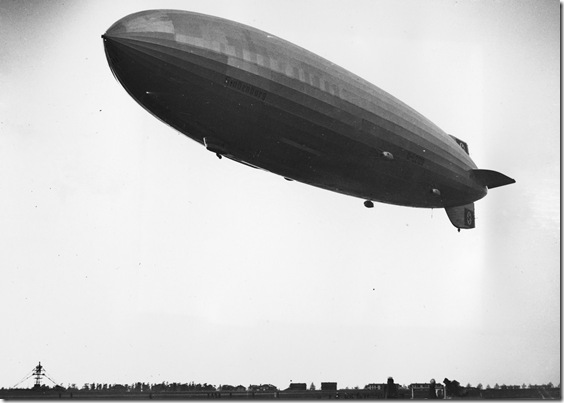
The Hindenburg approaches her final position over the landing field, held almost directly into the wind. Note that the elevators at the aft edge of the horizontal tail fins are still in the “hard down” position. Clearly, Boetius is trying to coax the last bit of dynamic lift from both the ship’s remaining forward motion and the wind itself.
7:21 PM - The Hindenburg has now come to a complete stop and is hovering just outside of the outer mooring circle rail. Captain Pruss orders the bow landing ropes dropped. Witnesses note a puff of dust from the landing rope coils as they hit the ground, despite the fact that the ground itself is rain-soaked. This indicates that the landing ropes are completely dry when they are dropped.
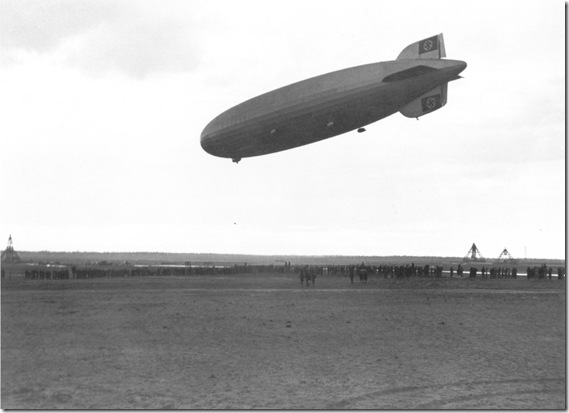 In this photo, also taken from the visitors’ area, the Hindenburg hovers just beyond the mooring circle, with its mooring mast visible at extreme left. The port landing rope coil has just been released and is visible below the ship as it drops to the ground. Note that the ship’s elevators are still hard down, even at this late stage of the landing maneuver.
7:22-7:24 PM - A light rain has begun, and the landing ropes are gradually becoming damp, thus increasing their conductivity. The ship's framework begins to ground itself electrostatically, with the outer cover doing so at a much slower rate due to its own lack of conductivity. A gust of wind strikes the Hindenburg's port side and pushes it off to starboard as the ground crew struggle to check its drift. In the ship's tail section, helmsman Helmut Lau climbs up a ladder on the forward port side of the lower fin, helping rigger Hans Freund to free a jammed rope as he hoists the stern mooring cable up from its storage space in the lower fin.

One of the last photographs taken of the Hindenburg prior to the fire. Her bow landing ropes have been dropped and the ground crew has pulled them off to port and starboard and begun to connect them up.
7:24 PM – Electrostatic discharge is now occurring at various points along the Hindenburg’s hull. Near the entrance to the air station, with a view of the starboard side of the ship against the darkening skies to the southwest, Professor Mark Heald and his wife and son watch the landing. Professor Heald suddenly notices a "dim blue flame" flickering along the Hindenburg's backbone girder from a point approximately 1/4 the length abaft the bow to the tail. He exclaims, "The thing's afire!" His son asks, "Where?" Heald replies, "Up there along the top ridge!"
7:25 PM - Helmut Lau, still standing on a small catwalk halfway up the portside of the lower tail fin and facing to port, hears a dull "frwump!" sound and his attention is drawn forward and upward to a sudden glow of fire on the front side of cell 4, toward the center line of the airship. The fire appears to be moving downward, and within a moment the entire gas cell melts and the fire grows very large and bright and rises toward the top starboard side of the ship.
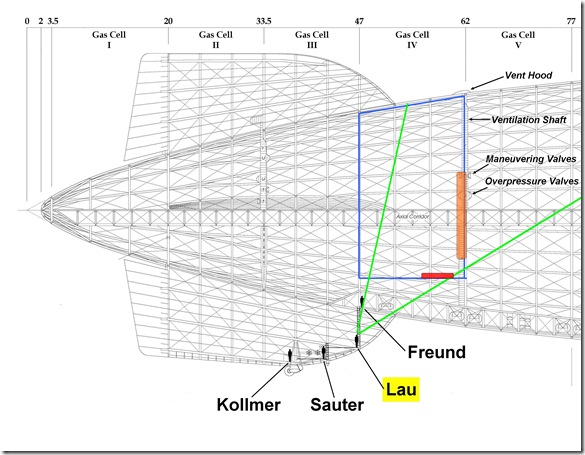 Helmut Lau’s field of vision at the moment he first saw the fire, adapted from his official Board of Inquiry testimony. Lau is looking up (field of vision in green) at the bottom of Cell 4 (blue). The red line shows approximately the area on the bottom of cell 4 through which he saw the glow of the fire. The location of the actual fire on the front of Cell 4, although Lau could not pinpoint exactly where it began before it burned its way downward, is estimated by the orange line. (Diagram courtesy of David Fowler)
 An aft view looking forward showing a different angle of Helmut Lau’s field of vision at the moment he first saw the fire. The blue line indicates the bottom of Gas Cell 4, and the green again represents Lau’s approximate field of vision from his position in the lower tail fin. The red line represents the area on the bottom of the gas cell where he saw the glow of the fire through the cell material, and the orange area indicates the general area where the fire itself could have been located on the forward side of the gas cell as it burned its way down. It was, as Lau said in his official testimony, above him and “slightly to starboard and definitely forward.” (Diagram courtesy of David Fowler)
Down on the ground, with a view of the port side of the ship, Boatswain's Mate Reginald H. Ward notices a distinct fluttering of the Hindenburg's outer cover up toward the top of the ship between Rings 62 and 77 (in the general location of cell 5, just forward of cell 4.) Within 2 to 3 seconds, Ward sees a ball of fire approximately 10 feet in diameter bursting through the outer cover, followed by a much larger detonation.

Witness diagram filled out by Boatswain’s Mate R.H. Ward, USN during his official testimony, showing the spot at which he first saw fire appear (orange circle), along with the ripples in the outer cover (small horizontal lines beneath orange circle) that he observed a few seconds prior to the fire.
Closer to the mooring mast, Willy von Meister, the American DZR representative to whom Captain Lehmann had expressed his disinclination to try to obtain helium the previous year, is looking toward the Hindenburg's tail when he notices an orange/yellow light atop the ship. The light appears to be just forward of the upper fin, upon which he can see the light reflected. As he would later recall to airship historian Henry Cord Meyer, "The flare plunged downward, apparently along the vertical gas shaft to about the center of the hull. For the tiniest moment it gave off a glow like a lantern being lit. Immediately there followed an upward, outward explosion and billowing of flame. All this occurred in fractions of a second."
Murray Becker, AP news photographer, is standing to the east of the mooring mast and snaps the following still photo with his Speed Graphic camera just as the entire aft half of the Hindenburg is engulfed by a rising ball of flame:

What we are seeing here in Becker’s photo is gas cells 1 through 9 erupting in flame almost simultaneously, as far forward as Ring 140. They didn’t necessarily all ignite at the exact same moment. Cell 4 just forward of the tail fins, we know from Helmut Lau’s testimony, breached and vented its hydrogen a split second before the cells on either side of it caught fire. The first outburst of fire visible to those on the ground seems to have been a fairly small bloom of fire atop the ship, forward of the upper fin (as described in R.H. Ward’s testimony, and repeated in very similar ways in the official testimonies of multiple other eyewitnesses on the ground.)
However, once the fire had taken hold inside the ship, it seems to have almost immediately produced the result we see in Becker’s photo above. The outer edge of the fireball above the hull is uniformly well-defined and level, indicating that one portion of the fireball did not begin rising prior to the rest of it as it would have if the photograph showed the fire progressively burning from one gas cell to the next or along the outer hull. The outer cover is still mostly intact from the forward engine car all the way aft to the tail fins, however the framework in that section is imploding, further indicating that the gas cells are being breached. Fire can also be seen within the ship through a jagged tear in the outer cover just below the front of the forward engine car.
When one also takes into consideration Lau’s statement (repeated later in his testimony) “The ship at the moment that the explosion went up had an acceleration down," it becomes clear that a very short amount of time passed between the moment Lau saw cell 4 “disappear by the heat” and the moment that Murray Becker took the above photograph.

The Hindenburg, the hydrogen in its aft cells consumed, very quickly drops to earth. However, the fire does not continue to progress forward along the ship’s outer cover. Instead, the fire is racing toward the bow along the axial catwalk and through the gas cells. At the moment captured in the above photo, the fire is already nearing the bow (per Kurt Bauer’s testimony) and cell 10 amidships has begun to burn, as evinced by the small plume of flame atop the hull just forward of the main fire. This is flame rising up from the ventilation shaft on the forward side of cell 10. A similar puff of fire had been observed above the ventilation shaft forward of cell 4 just before fire first engulfed the stern section.

A split second later, just as the tail section hits the ground, fire bursts from the bow as cell 16 is consumed. Fire will now burn its way back from the bow toward the tail as the aft fire begins to move forward. However, the fire continues to rage within the ship’s hull while the outer cover remains intact.
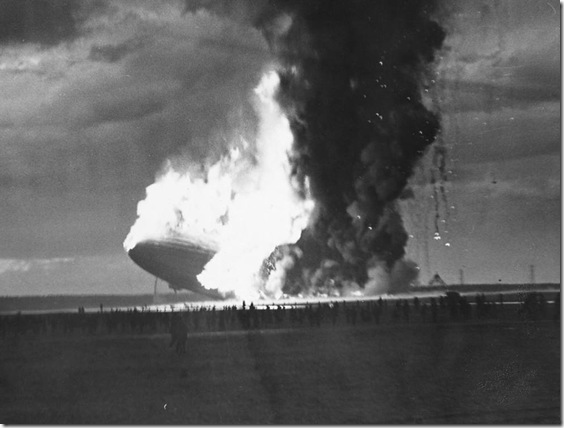
The Hindenburg’s forward section begins to fall as the gas cells within begin to burn. Flames begin to rise along the top of the hull and the fire from the aft section now moves forward as the bow fire moves aft.
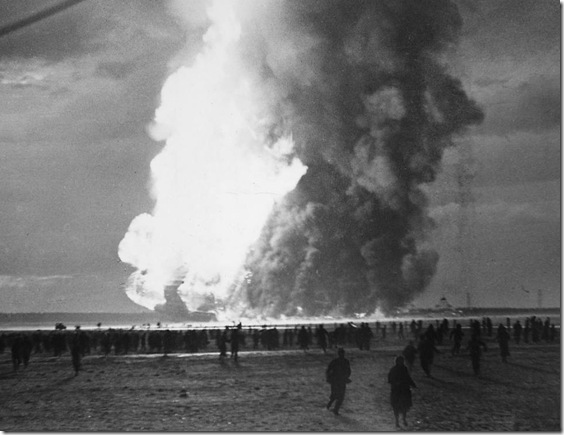
With the Hindenburg’s forward section is now almost completely ablaze, passengers begin leaping from observation windows now that the ship has neared the ground. The ship rebounds slightly on the hydraulic landing wheel under the control car touches the ground and the last intact gas cell (cell 14, behind the one remaining vertical strip of outer cover fabric) is finally consumed.

With all of its hydrogen burned off and the fire already subsiding, the Hindenburg finally collapses to earth for the last time. The bright flames generated by hydrogen burning through the mantle of fabric outer cover and gas cell material have now been replaced by dense black clouds of smoke from the tanks of diesel fuel oil that lined the ship’s keel walkway. Though quite a few spectators have retreated from the fire out of fear of the more violent hydrogen explosion that never came, the Navy and civilian ground crew are already running back to the wreckage in an attempt to rescue as many survivors as possible. The entire incident has taken just over half a minute.
There is, of course, no way to know exactly how the Hindenburg fire began, nor the precise location where the initial ignition took place. However, close examination of available photographic and eyewitness evidence combined with an understanding of the Hindenburg’s design and the conditions that were present at the time of her final landing approach indicate that although the disaster itself was incredibly dramatic, the so-called “mystery” behind the fire’s cause was far less so. It was a combination of events that had to occur all at the same time in order to start a fire – something which the Hindenburg’s operators could not have been expected to foresee.
As Dr. Eckener would later describe it to Harold Dick, a Goodyear representative who had worked in cooperation with the Luftschiffbau Zeppelin for a number of years:
“It was like being dealt four aces in a cold hand of poker – it might never happen again, and then it might happen the next day.”


 Crowds gather to watch the landing of the LZ 127 Graf Zeppelin in 1930


 The R-100 at the mast in Montreal in August of 1930. The double row of windows for the passenger decks can be seen as a half-circle arrangement just below the lettering on the side of the hull. Note also the tandem engine cars, similar to those intended for the LZ 128.


